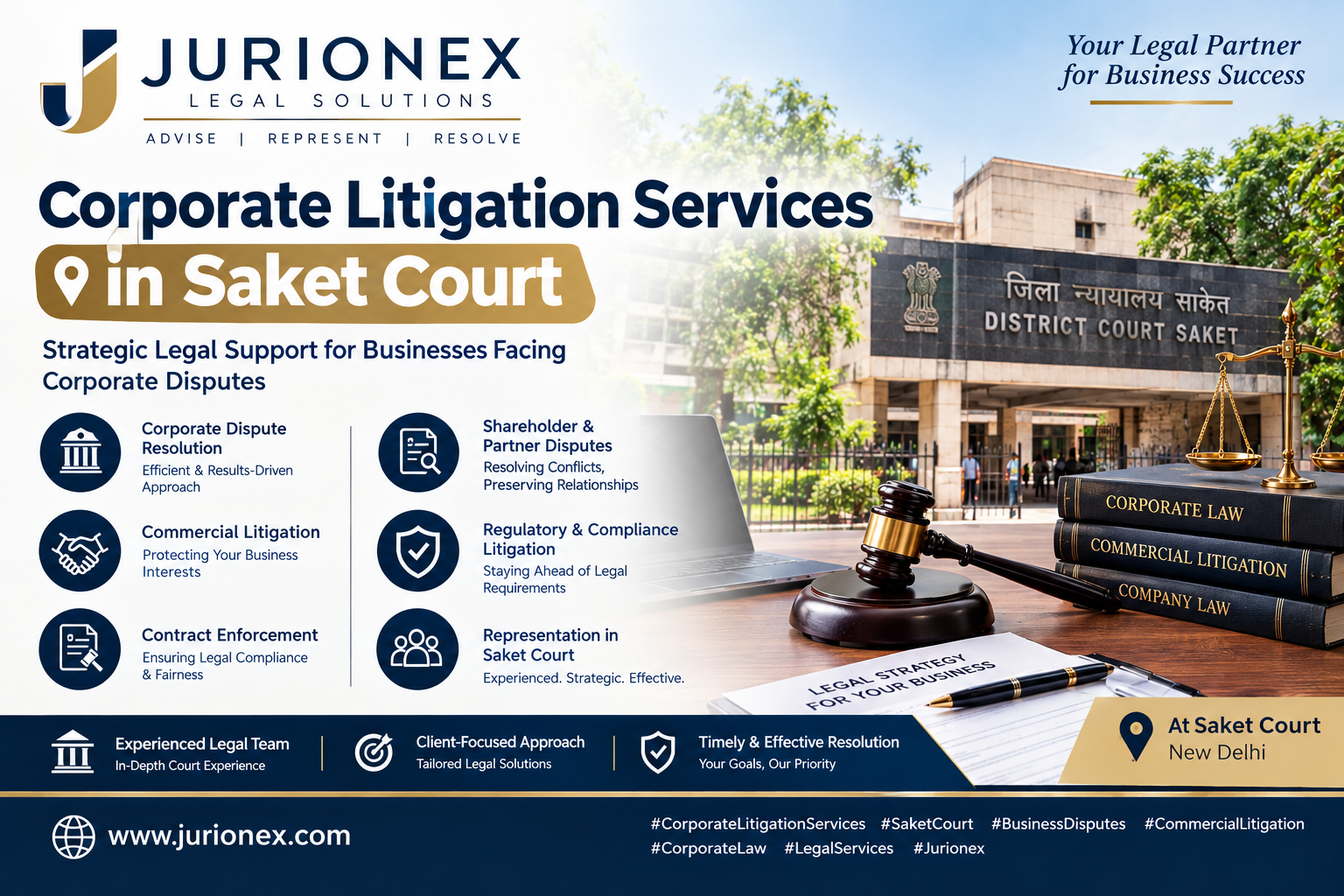
Businesses may face legal disputes involving commercial contracts, shareholder disagreements, company management, unpaid dues, partnership conflicts and other corporate matters. Understanding the available legal remedies and selecting appropriate legal representation can help businesses protect their interests and make informed decisions. Corporate Litigation Services in Saket Court can help businesses understand their legal options, prepare their cases and navigate applicable court procedures.
Corporate disputes can affect business operations, financial planning, commercial relationships and long-term growth. Whether a company is responding to a legal claim or seeking relief against another party, it is important to understand the nature of the dispute, the relevant documents and the appropriate legal forum.
For businesses seeking legal information and assistance, Jurionex provides a website to explore its legal services and learn more about available support for corporate and commercial legal matters.
Key Takeaways
- Corporate litigation may involve contractual disputes, shareholder conflicts, commercial recovery claims and company-related legal issues.
- The appropriate court or tribunal depends on the nature of the dispute, applicable legislation, territorial jurisdiction and monetary limits.
- Contracts, invoices, correspondence, board resolutions and financial records can be important evidence in corporate disputes.
- Early legal assessment may help businesses evaluate settlement options, litigation risks and possible remedies.
- Court deadlines and procedural requirements should be reviewed promptly to protect legal rights.
- Businesses should select legal representation based on relevant experience, communication, case strategy and the specific needs of the dispute.
What Are Corporate Litigation Services?
Corporate litigation services involve legal assistance in disputes connected with companies, commercial transactions, business relationships and corporate obligations. These services may include reviewing documents, assessing legal claims, preparing notices and pleadings, representing clients before appropriate courts or tribunals, and advising on settlement or enforcement options.
Corporate litigation does not refer to a single type of case. The applicable law and procedure depend on the facts and legal issues involved.
For example, a business may need legal assistance when:
- A customer or business partner fails to make payments under a contract.
- Shareholders disagree about company decisions or their rights.
- A supplier fails to fulfil contractual obligations.
- A company faces a claim alleging breach of agreement.
- A commercial transaction results in a dispute over payment or performance.
- A director, promoter or business partner becomes involved in a management-related disagreement.
Businesses considering Corporate Litigation Services in Saket Court should first identify the dispute’s legal nature and determine which forum has jurisdiction to hear it.
Types of Corporate Disputes Businesses May Face
1. Commercial Contract Disputes
Commercial contracts establish the rights and responsibilities of businesses. Disputes may arise when a party fails to deliver goods, provide services, make payments or fulfil another contractual obligation.
Common examples include disagreements involving service agreements, supply contracts, consultancy arrangements, distribution agreements and business-to-business transactions.
Legal assistance may involve reviewing the contract, examining correspondence, identifying possible breaches and assessing available remedies. Depending on the agreement and applicable law, the options may include negotiation, mediation, arbitration or court proceedings.
Businesses should retain signed agreements, amendments, invoices, delivery records, payment confirmations and written communications relating to the dispute.
2. Shareholder and Management Disputes
Disagreements between shareholders, directors or promoters can affect the management and stability of a company.
Such disputes may concern voting rights, access to information, board decisions, transfer of shares, management responsibilities or alleged violations of legal or contractual obligations.
The appropriate remedy depends on the company’s structure, its constitutional documents, the nature of the alleged wrongdoing and the legislation involved.
Certain company-law disputes may fall within the jurisdiction of the National Company Law Tribunal (NCLT), rather than an ordinary civil court. A legal assessment is therefore important before proceedings are initiated.
3. Recovery of Business Dues
Unpaid invoices and outstanding contractual payments can create cash-flow difficulties for businesses. A company may need to determine whether it should issue a demand notice, negotiate a payment arrangement, pursue a civil or commercial claim, or consider another remedy available under the law.
The best approach depends on the agreement, amount involved, evidence of liability, limitation period and whether any special statutory procedure applies.
Businesses should avoid assuming that every unpaid invoice automatically qualifies for a particular recovery process. The facts and applicable legal requirements must be examined first.
4. Partnership and Business Relationship Disputes
Disputes may arise between business partners concerning profit sharing, capital contributions, management decisions, contractual responsibilities or the dissolution of a business relationship.
A lawyer may review the partnership deed, shareholder agreement or other relevant documents to assess the parties’ rights and obligations.
Where possible, negotiation or mediation may help preserve business relationships and reduce disruption. However, if the dispute cannot be resolved amicably, formal legal proceedings may need to be considered.
5. Breach of Confidentiality and Business Obligations
Businesses often rely on confidentiality agreements, non-disclosure agreements and contractual restrictions to protect commercially sensitive information.
Disagreements may occur when a party allegedly discloses confidential information or fails to comply with contractual responsibilities. Legal options depend on the wording of the agreement, the evidence available and the relevant law.
Companies should maintain clear contractual documentation and records showing how confidential information was handled and what obligations the parties accepted.
Why Jurisdiction Matters in Saket Court
Selecting the correct legal forum is an essential part of corporate dispute management. A business dispute does not automatically belong before the court nearest to a company’s office or the location where its lawyer practises.
The appropriate forum may depend on:
- The place where the cause of action arose.
- The terms of the contract and any valid jurisdiction clause.
- The location and status of the parties.
- The amount claimed and applicable pecuniary jurisdiction.
- The nature of the relief requested.
- Whether a special statute assigns jurisdiction to a tribunal or another court.
- Whether arbitration or another agreed dispute-resolution mechanism applies.
Saket District Courts serve parts of South Delhi, but territorial and pecuniary jurisdiction must be assessed for each matter. Certain commercial disputes may also be subject to the Commercial Courts Act, 2015, where its requirements are satisfied.
The fact that a dispute concerns a company does not, by itself, determine whether it belongs in Saket Court, another district court, the Delhi High Court, the NCLT or an arbitral forum.
Before filing a case, businesses should obtain a jurisdictional assessment to reduce the risk of procedural objections and unnecessary expense.
How Corporate Litigation Services in Saket Court Can Assist Businesses
Legal assistance can be useful at different stages of a corporate dispute. The exact scope of work depends on the client’s requirements and the nature of the proceedings.
Initial Legal Assessment
The first step is to understand the dispute. This generally involves reviewing the agreement, relevant correspondence, payment records, notices and the events that led to the disagreement.
A preliminary assessment can help identify potential legal claims, available defences, evidentiary gaps and procedural concerns.
It should also consider the limitation period. Delays in taking legal action can affect the remedies available, so relevant deadlines should be checked promptly.
Drafting Legal Notices and Responses
In some disputes, a formal legal notice or a carefully prepared response may help clarify the parties’ positions and create an opportunity for resolution.
The need for a notice, its contents and the applicable deadline depend on the contract, the type of claim and the governing law. Some proceedings have specific statutory requirements that must be followed.
A notice should accurately state the relevant facts, contractual obligations, alleged breach and relief sought without making unsupported allegations.
Preparing Pleadings and Supporting Documents
Where litigation is necessary, the parties may need to prepare pleadings, applications, affidavits and supporting documents according to the applicable procedural rules.
The documentation should clearly explain the dispute, identify the legal basis for the claim or defence and connect the relevant evidence to the issues in question.
Corporate records should be organised carefully. If a company is a party, its authorisation and representation requirements should also be examined.
Court Representation and Case Management
Depending on the matter and applicable procedure, legal representation may involve filing documents, responding to applications, presenting arguments, attending hearings and complying with court directions.
Businesses should receive clear explanations of procedural developments, upcoming deadlines, possible risks and the decisions that may require their instructions.
No lawyer can guarantee a particular court outcome. A responsible litigation strategy should be based on the evidence, the applicable law and the realistic options available.
Settlement and Alternative Dispute Resolution
Not every commercial disagreement needs to continue through a full trial. Depending on the circumstances, parties may explore negotiation, mediation or arbitration.
Settlement can sometimes reduce costs, save time and preserve commercial relationships. However, any settlement should clearly address payment obligations, timelines, releases, confidentiality where appropriate and the consequences of non-compliance.
Where proceedings are already underway, the settlement terms and procedure for recording them should be reviewed before the parties finalise their arrangement.
Important Laws That May Apply to Corporate Disputes
The relevant legislation depends on the nature of the dispute. Some laws that may be relevant include the following.
Companies Act, 2013
The Companies Act, 2013 governs various aspects of company formation, management, governance and statutory responsibilities. Certain disputes involving company affairs, oppression, mismanagement or other specified company-law issues may fall within the jurisdiction of the NCLT or another designated forum, subject to the relevant statutory provisions.
Official reference: India Code
Commercial Courts Act, 2015
The Commercial Courts Act, 2015 provides a framework for designated commercial courts and the handling of qualifying commercial disputes. Its applicability depends on the statutory definition of a commercial dispute, the specified value requirements and other relevant conditions.
Certain commercial suits may also involve pre-institution mediation requirements when the statutory conditions apply and urgent interim relief is not contemplated.
Businesses should verify the current procedural requirements before initiating proceedings.
Arbitration and Conciliation Act, 1996
Where a valid arbitration agreement applies, a dispute may need to be referred to arbitration, subject to the agreement and applicable law.
The Arbitration and Conciliation Act, 1996 addresses matters such as arbitration agreements, arbitral proceedings, interim measures and enforcement of arbitral awards.
The existence of an arbitration clause does not mean every issue can be resolved in the same way. The wording of the clause and the legal nature of the dispute must be examined.
Indian Contract Act, 1872
The Indian Contract Act, 1872 is relevant to many disputes involving contractual obligations, breach of contract and remedies arising from contractual relationships.
The legal position depends on the agreement, the conduct of the parties and the applicable statutory provisions.
Businesses should obtain advice specific to their circumstances instead of relying only on general descriptions of contract law.
Documents to Prepare for a Corporate Litigation Matter
Proper documentation helps a legal professional understand the dispute and assess the available options.
Depending on the case, the following records may be useful:
- Signed contracts, purchase orders and service agreements.
- Amendments, addenda and related contractual documents.
- Invoices, payment receipts and bank transaction records.
- Emails, letters and other relevant communications.
- Delivery challans, work reports and proof of performance.
- Board resolutions and authorisation documents, where relevant.
- Company incorporation records and constitutional documents, where relevant.
- Legal notices and replies already exchanged.
- Previous court filings, orders or arbitration records.
- A dated chronology of the key events.
Businesses should preserve original documents and maintain complete records. Electronic communications should be retained in a form that preserves their context and authenticity. The requirements for admissibility and proof of electronic records should be considered where relevant.
Not every document will be necessary in every case. The legal representative can help identify which records are material.
How to Choose the Right Corporate Litigation Lawyer
Selecting legal representation is an important business decision. Companies should consider the following factors before appointing a lawyer or law firm.
Relevant Legal Experience
Look for experience related to the actual dispute, whether it concerns commercial contracts, shareholder disagreements, company-law issues, recovery proceedings or arbitration.
The lawyer should be able to explain the legal issues and identify the appropriate forum without making unsupported promises.
Clear Communication
Corporate disputes may involve complex legal and financial questions. A suitable legal professional should explain the available options, procedural requirements and potential risks in language the client understands.
Practical Case Strategy
A case strategy should consider the evidence, possible defences, financial implications, limitation periods and potential settlement opportunities.
Businesses should understand the proposed next steps and what information or decisions may be required from them.
Transparency About Fees and Scope
Before engaging a lawyer, discuss professional fees, court-related expenses, drafting work, hearing coverage and the scope of representation.
A written engagement arrangement can help clarify responsibilities and reduce misunderstandings.
Understanding of Business Priorities
Corporate litigation can affect management time, business relationships and operational continuity. Legal advice should consider the client’s commercial objectives alongside the legal merits of the case.
Businesses can visit https://jurionex.com/ to explore the firm’s website and learn more about its legal services. They should confirm the availability and scope of any specific service directly with the firm.
Common Mistakes Businesses Should Avoid
Companies can make a dispute more difficult to manage when they overlook basic legal and procedural requirements.
Ignoring legal notices: A notice should be reviewed promptly because it may require a response within a specified period or indicate an approaching deadline.
Relying on verbal promises: Important commercial terms should be documented wherever possible. Written agreements and contemporaneous records can help clarify what the parties agreed.
Deleting relevant communications: Emails, messages, transaction records and business documents may be important evidence. Relevant material should be preserved.
Filing in the wrong forum: The appropriate court or tribunal should be identified before proceedings begin.
Assuming litigation is always the best option: Settlement, mediation or arbitration may be worth evaluating where legally and commercially appropriate.
Waiting too long to seek advice: Delay can affect evidence, limitation periods and the practical availability of remedies.
Avoiding these mistakes cannot guarantee a favourable result, but careful preparation can help businesses make better-informed decisions.
Conclusion
Corporate disputes require a structured approach that combines legal analysis, documentary preparation and an understanding of business objectives. From contractual disagreements and unpaid dues to shareholder conflicts and company-law issues, the appropriate strategy depends on the facts, applicable law and jurisdiction.
Corporate Litigation Services in Saket Court may be relevant to businesses seeking guidance on disputes connected with the Saket District Courts, provided the matter falls within the appropriate court’s jurisdiction. Some corporate disputes must instead be pursued before a tribunal, another court or an arbitral forum.
Businesses should review their documents, identify relevant deadlines and obtain advice tailored to their circumstances before taking formal action. To learn more about available legal services, visit https://jurionex.com/.